

The South African Union for Progressive Judaism (SAUPJ) held its Biennial Conference over the weekend. Not only was it a privilege to spend time with our guest of honour, Rabbi Sergio Bergman, president of the World Union for Progressive Judaism (WUPJ), but as a movement, we gathered to discuss pertinent issues.
Here is the talk I was privileged to present with South Africa Nezter’s Mazkir, Julian Gordon. There was some diverse and thoughtful feedback – please feel free to share your views in the comments.
Lisa: Julian, how often have you met someone and headed straight online to look them up?
Julian: I’d say often. I usually look for them on Instagram first.
Lisa: Isn’t it an invasion of privacy?
Julian: Finding information through the likes of Google (and other social media platforms) is so common, that it’s now a verb. We Google people.
Julian: Halachically, even though the information is publicly available, it doesn’t mean it may be freely distributed. But there are two areas we need to cover here: idle gossip is prohibited, number one. Number two is privacy amongst neighbours. The Talmud teaches us that “loss of privacy is a kind of damage.” So, we put up walls between our neighbours for privacy.
Lisa: And yet, in the past two years – we’ve been in just about everyone’s living room, dining room, kitchen or study. There are faces we’ve never met, but we know their cat, dog and parrot by name. We know exactly which books are on their bookshelf, or what colour their lounge suit is.
Julian: Torah says “and you shall make for Me a Sanctuary, and I will dwell in your midst.” It’s got to include virtual sanctuaries, right? Or our own homes, I guess, as we log into that Zoom box or YouTube link and the homes we see on screen, too? I mean, don’t we, as progressive Jews, study values and practices online most of the time anyway?
Lisa: Fair point. So, you’re saying it’s not just about online services on Friday night in our slippers, whiskey discreetly placed offscreen?
Julian: Exactly, it’s more than just Zoomagogues
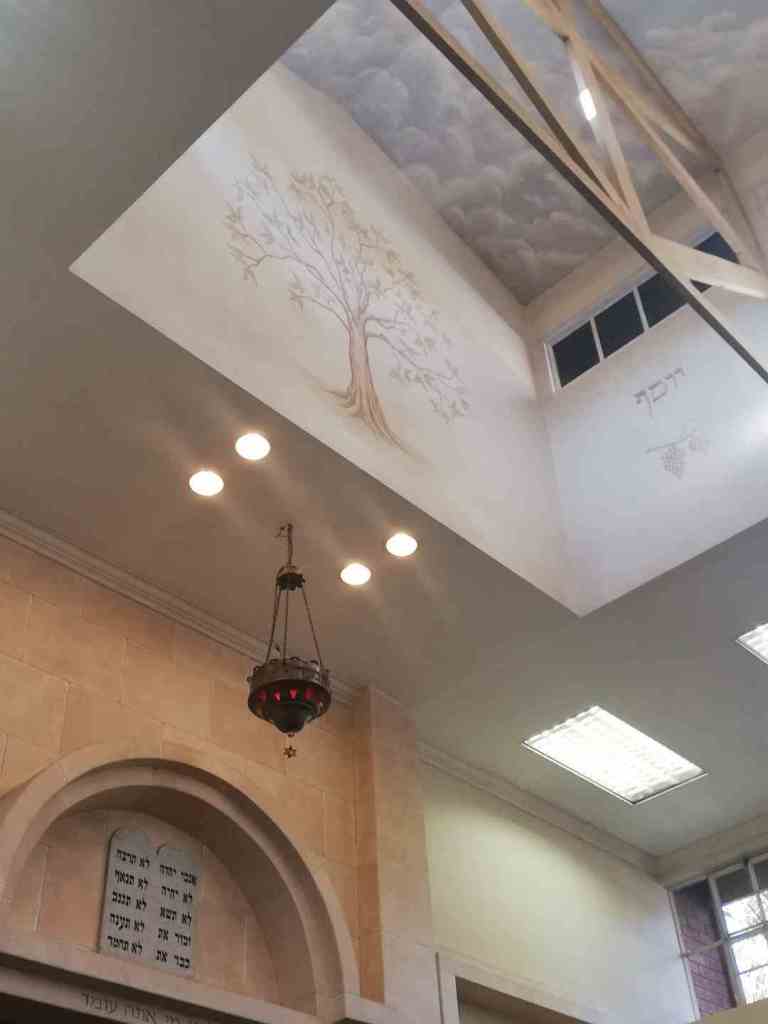
It’s Not Just About Zoomagogues
Lisa: There are many Jewish business people and along with running a business, comes the marketing and customer communication aspects. But, what if one is Shomrei Shabbat? What if they need to work on this day? And more interestingly, what if your business is not in a Jewish neighbourhood/area so fewer people know you’re not working on Shabbos?
Julian: These are the questions we must ask ourselves, especially in a South African context.
- One point I will speak to is the case when a potential client messages a Jewish businessperson on Shabbos. My response is this: it’s really up to you when to respond.
Lisa: Let’s say someone is mobile daily by electric wheelchair and as such, has difficulty moving without it. Can they use their wheelchair the whole week, Shabbat including? (including robot vacuums, Alexa, etc?)
Julian: Isn’t it stated halachically for Shabbat that if a device is already on, it may continue to be used?
Julian: Some turn to tech to feel connected in ways we can control and not be alone.
- It’s a feeling we miss from koch-ing with people in real life during the service, the brocha, the Shabbos dinners afterwards etc.
Julian: As Jews, we go through each part of our history just by moving through each challenge. We find ourselves doing that even today, as we’ve adapted to the online space and how it incorporates Jewish practices. We have, and always will, continue to continue.
Jews Do It Best (Lisa)
We continue to continue – it’s what Jews do best.
Before the advent of satellites and computers, the Jewish people already had the internet, or as I like to call it, Yenta-net, but rather the ancient communication network of exiled people from Germany to Russia, Yemen to India – all speaking one coding language – the Torah.
While the Torah was initially installed at Sinai, you could go so far as to say, we invented portable tech.
It’s no surprise when you think about it. Jews have continued to invent technology for generations. Edwin Land invented the Polaroid camera, and Evelyn Berezi designed the first word-processing computer. Motorola’s Israel Research and Development Centre came up with the original mobile phone technology. Philippe Kahn created the first camera phone. Robert Adler invented the remote control.
And here’s the real humdinger – Larry Page and Sergey Brin, two Yiddish boytjies – developed Google.
But before all of that, Jews invented the original search engine. With the Torah, the average teenager could do a quick mental search on anything from prenups to military strategy, divide it up into mental tabs, categorise it, mentally bookmark it and apply it when needed.
And what if this system crashed? A Jew makes a plan. Everybody, back in the day, had to write their own Torah scroll to carry around with them. It might not have taken selfies, but it certainly reminded them to be their best selves.
It goes to show that the Jewish people are survivors. We’re innovative. We find ways to break out of adversity and come up with different ways to navigate the world.
In an interview with Fast Company magazine, author Richard Worzel notes that “organizations and people succeed based on the quality of their information.”
So, we can say that the success of Jewish people is connected directly to the quality of information. Nowadays, technology spawns technology and not only do we experience Zoom fatigue, but also information overload. Even Moses experienced information overload. We’re taught that he stuttered until he received the Torah.
Think about it for a moment. Moses’s speech impediment meant he just couldn’t find the terms to explain all the links he’d tapped into. He saw the whole picture at once. He was stuck for words. And then came the Torah, cutting up the overwhelming information overload into coherent principles and readable stories. Dare I say that the Torah helped Moses to cut out the clickbait and get down to the most important, relevant tabs.
But just like the internet, Torah is an endless sea of information. Yes, it gave Moses a fluency with which to navigate the Jewish people through G-d’s mind by breaking everything down into bite-size symbols. Once he found his speech, Moses gave the Jews guidelines to cut through the clutter and instead of being redirected to the latest betting site like DreidalBets.com, he helped them arrive at the truth.
According to the Talmud, “when G-d made the world, he looked into the Torah.” He created a world where a Torah makes sense. And that’s what today’s tech is supposed to do – help us cope with reality. As content cascades, we seek systems to clarify the truth, to make sense of the world… to make life easier.
Let’s talk about the advances in biotechnology. It’s something that brings hope to many. We’re living longer than ever before. Cures turn infectious diseases into inconveniences rather than life-threatening illnesses. And Judaism always applauds medical breakthroughs. It’s the number one value, isn’t it: Pikuach Nefesh.
Speaking of which, how many of you have joined WhatsApp or Facebook Tehillim groups? How many of you are on a community or shul broadcast group?
Now, how many of you have, especially since the start of the pandemic, had to help Bobba with her technology?
Well, you can even leave the tech to tech. Elli-Q, a robotic companion created by an Israeli company called Intuition Robotics, is designed to be an ageing companion, keeping the elderly engaged by helping them to access and connect to video chats, social media, online games and all sorts of community services and events. Sure, it’s not designed to be a living, breathing friend or solve loneliness, it can help the elderly overcome barriers and bring people from around the globe together like never before. Robotics can help older adults intuitively interact with technology and connect with their community, content and families.
Today’s technology – a lot of which is Jewish-invented – is supposed to help us cope with reality. Our view of technology is no different from our view of any other aspect of life. Yes, we can perform technological feats, but we still look to the Torah for answers. It is still up to us to decide how to ethically channel our discoveries and when to separate the information overload wheat from the chaff.
Fortunately, we need not wait for the next Window’s update or Microsoft Messiah version 2022. We have the Torah – the ultimate smart technology that helps us to clarify and move through life with crystal-clear focus.
So, halachically, Julian, where do we stand on Zoomagogues and online events?
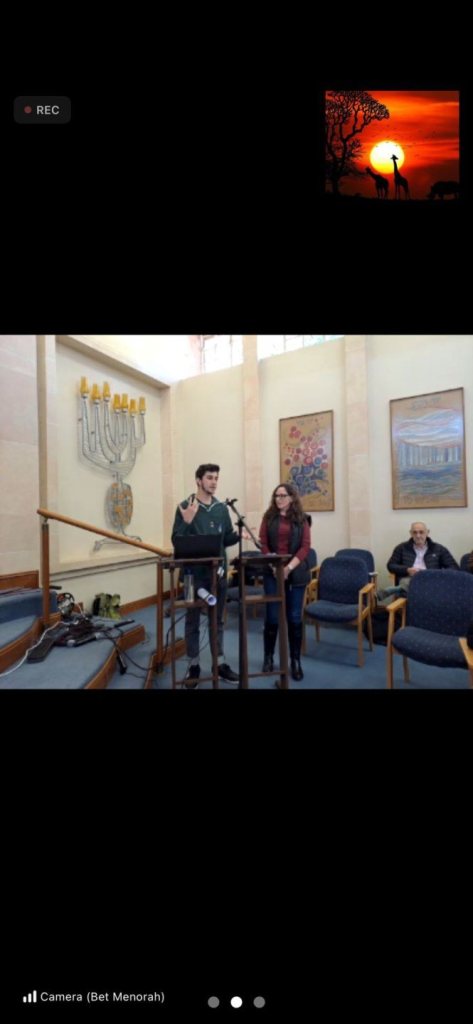
The Modern Shul Service (Julian)
a. We now use technology to broadcast Shabbat services. It seems it’s acceptable to use technology at this time of the week because it’s halachically necessary. It allows everyone in the community to join for the most important day of the Jewish week.
- Online events are incredibly essential to engaging the community, especially at a time when we can’t have everyone together.
- As Netzer, these were vital to keeping relevant during the pandemic.
- Technology is allowing participants from around the world to come together.
- Despite impersonal and technical characteristics of online events, we can still create meaningful engagement between in-person and online participants in a hybrid situation.
e. Tech has opened up Judaism to people who may not feel comfortable walking into a shul (interfaith relationships, the curious, secular Jews). It allows these people to engage in an online spiritual community.
b. A Jew is transported to Shul in an autonomous vehicle. It’s fine, surely? They’re not doing the work.
g. The opportunity to engage a wider network of people in Jewish experiences online is a revolutionary development.
h.
- Twitter Space (virtual audio-only platform where anyone can speak and listen)
- Early 2022 synagogue shooting
- Writer wasn’t expecting more than two hours of prayer
I mean, we are Jews aren’t we? Isn’t that how we’ve always gone through history. We continue to continue.
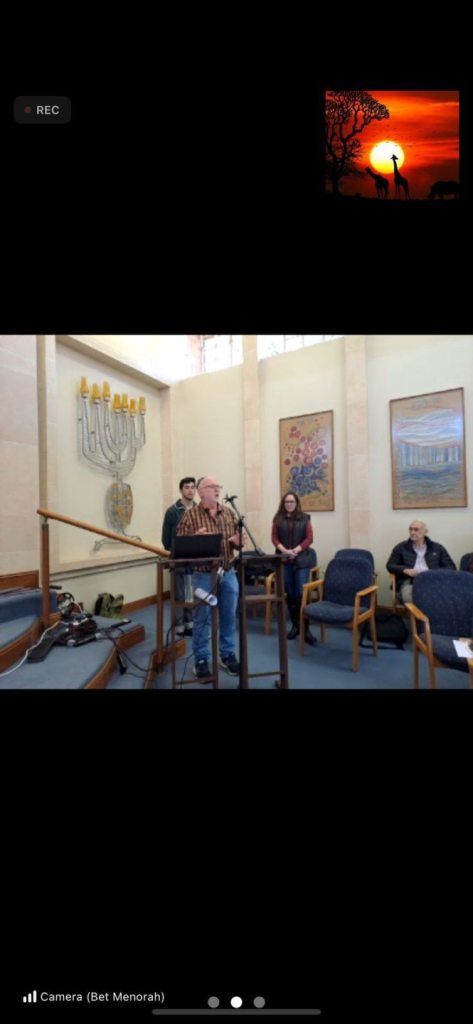
Conclusion/Open for Discussion
Lisa: Thanks, Julian. I couldn’t agree more, we continue to continue. So, let’s take it to the audience for a moment and talk about a few pros and cons of tech in progressive Judaism.
Julian:
1. Significant investment is required for the tech and staffing thereof to produce high-quality live streams. [CON] – what are you doing in your shuls to mitigate these expenses or is it a point you’re currently battling with?
- AUDIENCE INTERACTION
Lisa:
2. A multi-access hybrid approach is likely here to stay, curing the loneliness of those who desire a sense of involvement and community. We shouldn’t turn away from our devices, but we should develop a self-aware relationship with them – and with one another. [CON into PRO] For those congregations who use a hybrid approach, what benefits and what downfalls are you experiencing?
- AUDIENCE INTERACTION
Julian: But there’s a lovely feeling that the sometimes lack of/disallowal of technology in Judaism provides for us. It’s therapeutic to disconnect (and it’s a good detox)
Julian: Disconnecting lets us cancel out the noise and connect with our soul and Hashem in “real time.”
Lisa: Shavuot is coming up – it’s probably no coincidence that G-d chose a mountainous desert for the Divine revelation – as far from civilization as possible. For people to hear the Divine, it could only happen in a place barren of cultural reference points. No noise. No distraction. Just one-on-one interaction.
 Nachas & Drash