
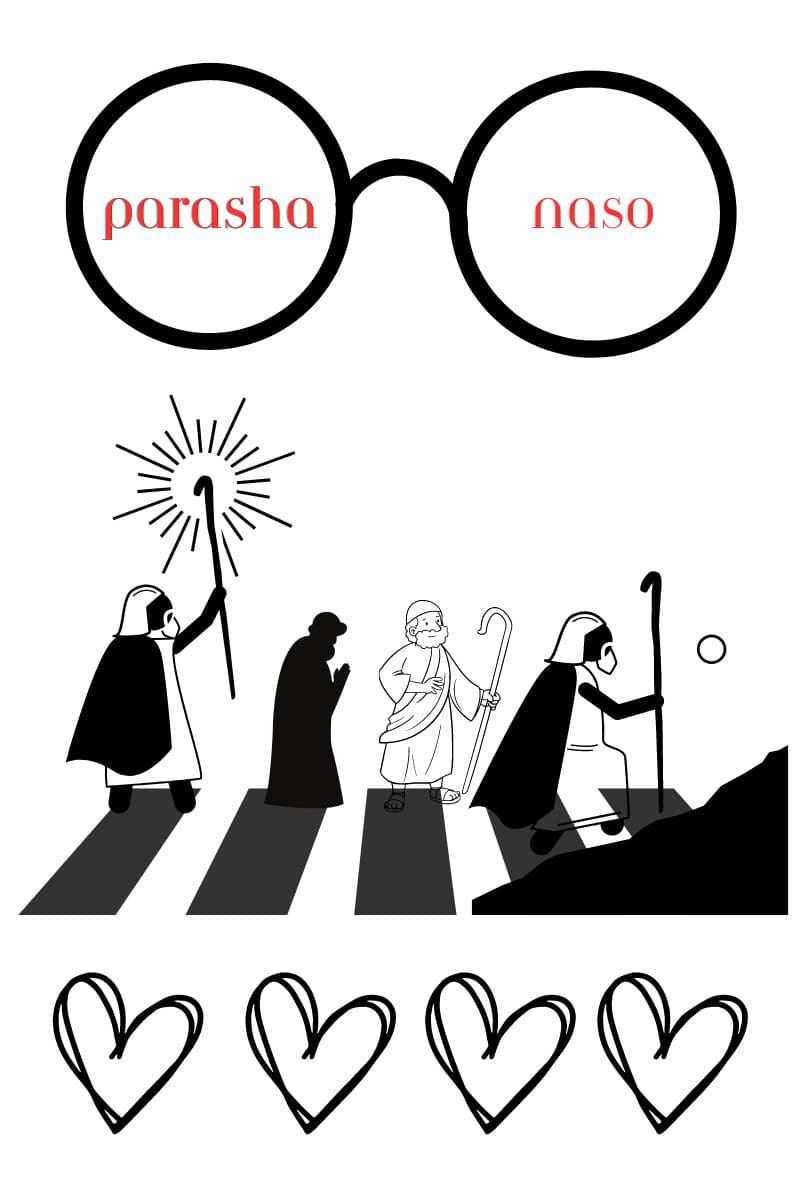
Parasha Naso is about love – the love between parent and child, partners, and the love between the Divine and His people. This week’s portion is a beautiful reminder that love is the core foundation of our relationships.
But what does love mean? And why are the Kohanim instructed to bestow their priestly benediction “with love?”
What’s love got to do with it, if you will?
Love Me Do
This week, we learn that G-d tells Moses to command the High Priest-Kohen, Aaron and his sons:
“…so shall you bless the children of Israel: Say to them, ‘May the Lord bless you and keep you; May the Lord cause His face to shine upon you and be gracious to you; May the Lord lift his Face towards you and grant you peace.’” (Numbers 6:23-27)
The priestly benediction is a regular part of services. Just before they bestow the blessing, the Priest-Kohanim say,
“Blessed are You, O Lord our G-d, King of the Universe, who has sanctified us with the sanctity of Aaron, and commanded us to bestow a blessing upon His nation Israel with love.”
This blessing, combined with the priestly benediction, is a profound expression of divine love and care. It conveys the idea that Hashem is gracious, protective and brings peace, justice and mercy. It encourages love and kindness amongst one another and underscores the significance of fostering harmonious relationships. It’s a reminder to treat others with compassion, respect and love.
I Want to Hold Your Hand
The Beatle’s song, I Want to Hold Your Hand, is all about the anticipation and excitement of being in love – a reminder that sometimes the simplest of things can mean so much.
The simplicity of the blessing – the words and their three, five and seven-word structure, their flow from protection to grace and to peace, make them a gem. This is a prayer that has an unwavering power.
In fact, you’d be hard-pressed to find any other blessing that specifies it be done with love.
The intimacy with G-d and the ability to act as His helper isn’t limited to priests or the elite. Jewish tradition places the sacred blessing in the mouths of every parent as part of weekly practice. But it’s not limited to parents, either.
Think of it like the Righteous Brother’s song, Unchained Melody – like the lyrics of the song, this week’s portion speaks of a love that lasts beyond time and space.
When we bless someone, it demonstrates wanting the best for them.
Is this not what love means?
When Priests bestow blessings, they depict what the love of another looks like. Love is how blessings enter our world, and how we care for others.
The long and winding road
Long and Winding Road, The Beatles
That leads to your door
Will never disappear
I’ve seen that road before
It always leads me here
Lead me to you door
Love Me Do
Unconditional love is present in Naso, as G-d promises to be there always for the Israelites, even in their weakest moments.
When the Israelites stood at the base of Mt. Sinai awaiting the gift of the Torah, the excitement was nothing short of palpable. Torah, they believed, was a tangible symbol of the Divine’s love. Just the way a parent’s rules establish boundaries, so, too, does G-d’s boundaries help us refine our behaviour to be the best versions of ourselves.
There is an everlasting bond between G-d and the Israelites. Just think about the pertinent principles set out in Torah that we should review regularly:
- Love the Eternal your G-d (Deuteronomy 6:5)
- Love those who are different from you (Leviticus 19:34)
- Love those who are like you (Leviticus 19:18)
Love in the Torah is not an emotion, but rather how we behave. We learn about it from how G-d treats us – with justice (tzedek) and mercy (rachamim). When we act with justice and mercy, then, do we not fulfil the commandment to love the stranger, our fellow and the Eternal?
Give Peace a Chance
Religiously, we’re instructed to act with mercy and justice to everyone – those like us, and those who are not like us. When a person violates that ethic of love, justice must be delivered mercifully. When we violate this ethic, we are to admit our error and set off on a path of bringing justice to the situation.
The commandments to love set out to help us grow. They’re not just for those who show mercy and justice, they’re also for those who don’t love us. It’s up to us to reflect and take responsibility. When we institute mercy and justice in our lives, we give peace a chance.
Do You Want to Know A Secret?
Responsibility and love, as we learn this week, are inextricably intertwined. The Hebrew word, ahavah comes from the Aramaic word for ‘giving.’ Just the way the Priest-Kohanim act as the agent of G-d, attempting to brand the nation with G-d’s love and justice, so, too, are we responsible for spreading the love.
And it starts with you.
The Torah emphasises the importance of mental and physical self-care. By taking care of our body and mind first, we’re better able to fulfil our responsibilities of “love your neighbour as yourself” (Leviticus 19:18) and spreading that love, justice and mercy to our communities. We’re better positioned to love and take responsibility for others, just like Hashem does for us.
All You Need Is Love
Love is the foundation of our relationships. Parasha Naso teaches about the importance of love in several contexts. It teaches us about the importance of commitment and the power of love.
Love is a foundational principle that guides us in leading fulfilling and righteous lives. Sometimes, though, we need a little help from our friends – the Priest-Kohanim – to remind us that we need to trust in G-d and his plan for us.
As we navigate life’s long and winding road, let’s remember the beautiful blessing and ask the Divine to bless us and keep us, to grant us peace and to help us act with justice and mercy. With love.
Shabbat Shalom.
 Nachas & Drash